
Skip to content
Don't get frustrated!! Call us. We answer our phones.480-995-0878
Serving
A couple talk in their desert-landscaped front yard in the Phoenix Valley while a septic vacuum truck waits at the curb
Serving the Greater Phoenix Valley & All Surrounding Areas

Septic serviceBuilt to last

We show up when we say we will, you get the price before we start, and before we leave, we walk you through what we found in your tank.

Call us: 480-995-0878
Why Steel Septic

Built on strength. Built for trust.

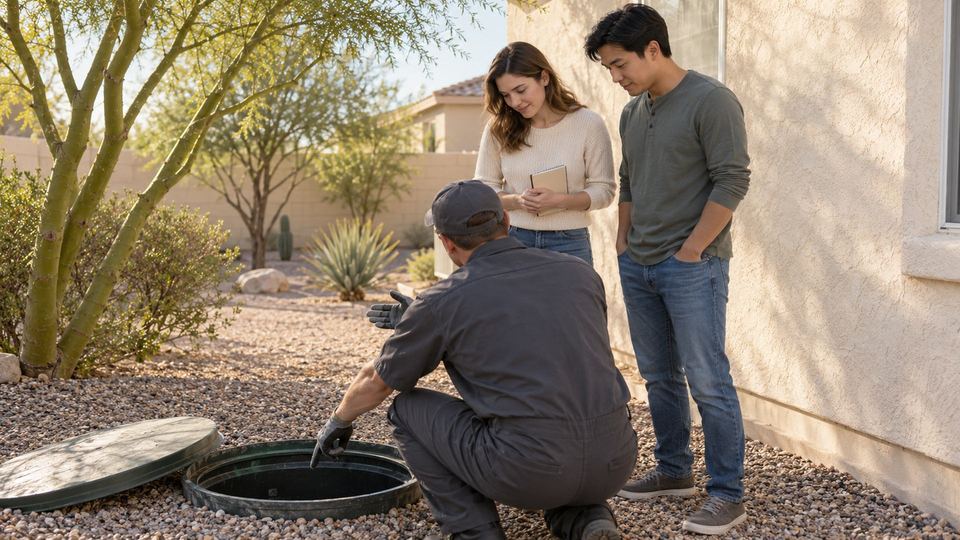
A technician crouches at an open septic tank lid and explains the system to a young couple, one holding a notebook, in the side yard of a Chandler home

Locally owned

Phoenix-based. We live here, we serve here. Your neighbors running your septic service.

Built right

We do the job right the first time. No shortcuts, no corners cut.

Honest work

If one sink is slow, it's a clog, not your septic system. We tell you that.

NAWT certified

Owner Bobby Lanham is NAWT certified.

Bobby Lanham, founder of Steel Septic and Environmental, in a ball cap and patterned fishing shirt
Meet Bobby

Bobby Lanham

35+ years in the septic industry. Built the old-fashioned way: through grit, repetition, and decades of doing real work in the field.

Read Bobby's story

A mother and her teenage daughter sit close together at a patio table behind their Mesa home, smiling with relief now that the septic problem is fixed

We're open. Book your service.

Fill out a short form and a real person gets back to you, with the price before we start.

FAQ

Septic questions, answered

How often should I pump my septic tank?

Every 1 to 3 years for most homes. A large household builds sludge fast, so pump sooner if you have a big household, a smaller tank, or a garbage disposal you use a lot, or if a check finds the sludge or scum layer getting close to the outlet. If your tank has an effluent filter, clean it at least once a year.

Why is there always water in my septic tank? Is it backed up?

No. A septic tank is a displacement system and has to be full to work. The water level is what lets the tank separate solids to the bottom and scum to the top. Water sitting at the normal level is exactly right. The warning sign is water rising into the overflow tube. That points to a float adjustment, not a full tank.

What are the warning signs my septic system is in trouble?

Watch for every drain in the house running slow (one slow sink is just a clog: sinks alone never indicate a septic problem), gurgling in the toilet or bathtub, sewage backing up at the lowest fixture (usually the bathtub, since it's the closest low point to the tank), foul odors indoors or over the tank, and soggy or bright green patches in the yard. If it's showing up everywhere, not just one fixture, it's the system.

Are "flushable" wipes safe for a septic system?

No, not even the ones labeled "flushable," "biodegradable," or "septic safe." They don't break down in the time a septic system is designed for, and in volume they plug your lines. We've pulled up to tanks packed solid with wipes. They can destroy a leach field in a few years. The label is selling a product, not protecting your system.

What should I never flush or pour down the drain?

Flushable wipes, tampons, diapers (adult and child), intimacy products, and grease. Also keep chemicals out: Drano®, chlorine tablets, and heavy bleach. People dump Drano in a slow drain expecting a fix, but all it does is kill the bacteria your system runs on. For grease: scoop it into a jar and throw it in the trash. It never settles. It floats and builds up your scum layer.

Does RID-X® or a tank additive mean I never have to pump?

No. An additive can create a better environment for the bacteria that break down solids, but it will never remove the solids for you. You still have to pump.

My drain is slow. Should I pour Drano in it?

Don't. On a septic system, Drano and heavy chemicals mostly just kill the bacteria doing the work, and you're left with the same clog plus a damaged tank. If one drain is slow, it's usually a localized clog. If every drain is slow, call a pro before you make it worse.

How do I know if a septic company actually knows what they're doing?

Listen to their questions. A good company shows up with a game plan, not a shovel and a guess. On the phone they should ask where your tank is, when it was last serviced, whether it has a riser, and why you're calling: routine maintenance or an active backup. If they're not asking questions, that's a company that'll come out, dig around, and run up charges.
Folded charcoal coveralls, gloves, a cap, work boots and a thermos on a workbench, with a vacuum truck outside at sunrise
Now Hiring

We're hiring

Pump Truck Drivers and Construction & Repair crew wanted. Join our team.

View Open Positions